Are you a Master's student interested in conducting research that advances disability inclusion in Nepal? This is your opportunity to contribute to evidence-based policy, advocacy, and inclusive development.
The Blind Youth Association Nepal (BYAN), under the YATRA (Youth-Led Actions for Transformation Through Rights-Based Advocacy and Disability Movement) Project, in partnership with CBM Global Disability Inclusion, invites applications for the University Research Grant on Disability Inclusion.
Grant Amount: NPR 50,000 per selected research
We welcome research proposals on disability rights, inclusive education, employment, gender, health, accessibility, climate action, governance, digital accessibility, social protection, and other disability-related themes. Master's students from all academic disciplines are encouraged to apply.
Research conducted in Bagmati Province (Kathmandu and Chitwan) and Madhesh Province (Bara, Rautahat, Sarlahi, Mahottari, and Dhanusha) will be given preference; however, applications from other parts of Nepal are also encouraged.
🗓️ Application Deadline: 25, August 2026
📄 For full information and the complete Terms of Reference (TOR), please visit:
Jobs Nepal – University Research Grant on Disability Inclusion
For further information:
📧 Email: [email protected]
📞 Phone: +977 9714559949
Join us in generating evidence that promotes disability inclusion and creates lasting impact across Nepal.
यात्रा परियोजनाको स्थानीय साझेदार संस्थाको लागी दर्खास्त आह्वान
Call for Expression of Interest for Local Implementing Partners of YATRA Project
आवेदन सम्बन्धी विवरण
| संस्था | नेत्रहीन युवा संघ नेपाल (BYAN) |
| साझेदार संस्था | CBM Global Disability Inclusion |
| परियोजनाको नाम | "YATRA" परियोजना |
| आवेदन म्याद | वि.सं. २०८३ असार ८ गते (24th June. 2026) |
| आवेदन पेश गर्ने ठाउँ | google form |
| वैकल्पिक व्यवस्था | [email protected] |
संस्थाको परिचय:
नेत्रहिन युवा सङ्घ नेपाल दृष्टि सम्बन्धी अपाङ्गता भएका युवाहरूद्वारा स्थापित र सञ्चालित संस्था हो। वि.सं. २०६८ मा स्थापना भएको यस संस्थाले देशभर दश शाखामार्फत अपाङ्गता भएका बालबालिका तथा युवाहरुको अधिकार सुनिश्चिततता, सशक्तिकरण र समावेशिकरणको लागी सचेतना, क्षमता विकास, पैरवी र समावेशी विकासको माध्यमद्वारा कार्य गर्दै आइरहेको छ। यस संस्थाले खासगरी समावेशी शिक्षा, स्वास्थ्य समता, राजनितिक सहभागीता, समावेशी जलवायु न्याय, रोजगारी प्रवर्धन तथा नितिगत् पैरवीको क्षेत्रमा कार्य गर्दै आइरहेको छ।
पृष्ठभूमि
नेत्रहिन युवा सङ्घ नेपालले CBM Global को साझेदारीमा “YATRA (Youth-Led Actions for Transformation through Rights-Based Advocacy and Disability Movement)” परियोजना अप्रिल २०२६ देखि मार्च २०२९ सम्म सञ्चालन गरिरहेको छ। यस परियोजना बागमती र मधेश प्रदेशका बारा, रौतहट, सर्लाही, महोत्तरी, धनुषा र चितवन जिल्लामा कार्यान्वयन भइरहेको छ यस परियोजनाको मुख्य उद्देश्य अपाङ्गता भएका व्यक्तिहरू, विशेषगरी युवा तथा कम प्रतिनिधित्व भएका समूहहरूलाई आफ्ना अधिकार प्रयोग गर्न, नेतृत्व विकास गर्न तथा समावेशी शासन प्रणालीमा अर्थपूर्ण सहभागिता जनाउन सक्षम बनाउनु हो। यस परियोजनाले क्षमता अभिवृद्धि, युवा आन्दोलन निर्माण, प्रमाण तथा तथ्यांक विकास र नीति पैरवीलाई प्रमुख रणनीतिक मार्गका रूपमा अवलम्बन गरेको छ।
YATRA परियोजनाको एक महत्वपूर्ण क्षेत्र “अपाङ्गता भएका व्यक्तिहरूको सार्थक सहभागिता” को सिद्धान्तअनुसार अपाङ्गता भएका व्यक्तिहरूका संस्थाहरू (OPDs) लाई सबल बनाउनु हो। यस उद्देश्यका लागि परियोजनाले बारा, रौतहट, सर्लाही, महोत्तरी, धनुषा र चितवन जिल्लामा कार्यरत करिब २० वटा OPD हरूसँग साझेदारी गर्दै लघु अनुदान तथा क्षमता सुदृढीकरण सहयोग प्रदान गर्नेछ। तीमध्ये १० वटा OPD हरू छनोट गरी संस्थाको क्षमता विकाश र स्थानीय स्तरमा पैरवी गर्नको लागी लघु-अनुदान प्रदान गरिने छ। उक्त दश ओटा साझेदारहरूमध्ये ६ वटा OPD हरू स्थानीय तहसँग प्रत्यक्ष रूपमा अपाङ्गता समावेशी शासन तथा पैरवी कार्यको लागी छनोट गरिने छ भने बाँकि ४ वटा OPD हरू न्यून प्रतिनिधीत्व भएका समुह तथा सिमान्तकृत समुदायका अपाङ्गता भएका व्यक्तिहरूको क्षमता विकासका लागी क्षमता विकास साझेदारको रूपमा छनोट गरिने छ। क्षमता विकास साझेदारहरू अन्तर्गत् कम प्रतिनिधित्व भएका समूहहरू, विशेषगरी श्रवन-दृष्टिविहिन तथा बौद्धिक अपाङ्गता भएका व्यक्तिहरूका संस्थाहरू, अपाङ्गता भएका महिला, दलित तथा अन्य सिमान्तकृत समुदाय लक्षित संस्थाहरूलाई प्राथमिकता दिइनेछ। लघु-अनुदानमा छनोट हुन नसकेका अन्य १० ओटा OPD हरूलाई पनि मूल्याङ्कनका आधारमा मार्गदर्शन (Mentorship) तथा संस्थागत विकास सहयोग प्रदान गरिनेछ।
लघु-अनुदानका लागी छनोट भएका संस्थाहरूले परियोजना अवधिभर क्षमता सुदृढीकरण, सह-डिजाइन तथा प्राविधिक सहयोगसहित करिब दुई वर्षको अवधिको लागी करिब रु. ८,००,००० ( रु. आठ लाख ) राबरको अनुदान प्राप्त गर्नेछन् छन | यस्तै, ति संस्थाले परियोजनाका हरेक कृयाकलापहरूमा साझेदार संस्थाको रूपमा काम गर्ने छ। यस प्रक्रियामार्फत अपाङ्गता भएका व्यक्तीहरू द्वारा सञ्चालित संस्थाहरू OPD हरूको संस्थागत क्षमता अभिवृद्धि, स्थानीय तहमा प्रभावकारी पैरवी, युवा नेतृत्व विकास तथा दिगो अपाङ्गता आन्दोलन निर्माणमा योगदान पुर्याउने लक्ष्य राखिएको छ।
उद्देश्य:
यो कार्यशर्तको उद्देश्य नेत्रहीन युवा संघ नेपाल (BYAN) ले 'YATRA' परियोजनाका तोकिएका पालिकाहरूमा अपाङ्गता भएका व्यक्तिहरूको संस्था (OPDs) लाई स्थानीय स्तरमा कार्यान्वयन साझेदारको रूपमा चयन गर्ने प्रक्रिया निर्देशित गर्नु हो । छनौट भएका OPD हरूलाई उनीहरूको संस्थागत प्रणाली सुदृढ गर्न र सम्बन्धित नगरपालिकाहरूमा वकालत पहलहरूको नेतृत्व गर्नका लागि आर्थिक अनुदान र क्षमता विकास सहयोग प्रदान गरिनेछ ।
संस्था/समूह छनौटका न्यूनतम आधारहरू:
स्थानीय साझेदार संस्था छनोटका लागी न्यूनतम निम्न आधारहरू तय गरिएका छन्-
- संस्था स्थापना भई कम्तिमा २ वर्षदेखि निरन्तर रूपमा सकृय रहेको,
- सम्बन्धित जिल्ला या पालिकामा दर्ता या सूचिकृत भई सम्बन्धित पालिका या नजिकको पालिकामा कम्तिमा दुई वर्षदेखि निरन्तर रूपमा कार्य गरिरहेको (कुनै संस्थाको शाखाको हकमा सुचिकृत भई काम गरेको या सम्बन्धित पालिकासँग काम गरेको प्रमानहरू पेश गर्न सक्ने),
- अपाङ्गताभित्र पनि युवा, महिला या सिमान्तकृत समुदाय र न्यून प्रतिनिधित्व भएका व्यक्तिहरूको संस्था (न्यून प्रतिनिधित्व समुहको हकमा, अभिभावकहरूद्वारा सञ्चालितस्व-वकालतकर्र्ताहरूको अर्थपुर्ण सहभागीता र प्रतिनिधित्व भएको संस्थालाई समेत मान्यता दिइने)
- अपाङ्गता भएका व्यक्तीहरूको हक, हित र अधिकार प्राप्तीका लागी निरन्तर रूपमा सकृय रहेको,
- संस्था दर्ता तथा नविकरण अत्यावधीक गरिएको (शाखाहरूको हकमा, सम्बन्धित शाखाहरू निरन्तर रुपमा कार्यगरिरहेको प्रमाणहरू संस्थाले पेश गरेर सिफारिस गर्न सक्ने),
स्थानीय/प्रदेश या सङ्घीय सरकारमार्फत अनुदान प्राप्त गरी सञ्चालन गरेको या अन्य गैरसरकारी संस्थामार्फत लघु-अनुदान प्राप्त गरी परियोजना सञ्चालन गरेको अनुभव भएको,
संस्था सञ्चालनको लागी आवश्यक न्यूनतम निति तथा नियमावलीहरू तयार गरी अनुमोधन गरेको,
कुनै पनि भ्रष्ठाचार, अनियमितता या गैरकानुनी कृयाकलापहरूमा सहभागी नभएको या नमुछिएको,
संस्थाको नाममा छुट्टै बैङ्क खाता रहेको,
(छनोट सम्बन्धी अन्य व्यवस्थाहरू संस्थाले बनाएको मापदन्डअनुसार हुने छ)
नेत्रहीन युवा संघ नेपाल (BYAN) सधैं समानताको सम्मान र प्रवर्द्धन गर्दछ, साथै संघ अपाङ्गता, लिङ्ग, आर्थिक अवस्था, रङ, धर्म, जातजाति, भूगोल वा अन्य कुनै पनि आधारमा कुनै पनि प्रकारको भेदभाव, दुर्व्यवहार र हिंसाको विरुद्धमा छ । त्यसैले सम्पूर्ण संस्थाहरूले BYAN को बाल संरक्षण तथा सुरक्षा नीति र यौन हिंसा, शोषण र दुर्व्यवहार विरुद्धको संरक्षण नीतिमा उल्लेख गरिएका सबै प्रावधानहरू पालना गर्नुपर्नेछ ।
लघु-अनुदान प्राप्त गर्ने संस्थाका प्रमुख जिम्मेवारीहरू तपोशिलबमोजिम रहेका छन्-
- सम्बन्धित पालिकामा पैरवी, सचेतना र अन्य तोकिएका गतिविधिहरू सञ्चालन गर्ने,
- अपाङ्गता भएका युवाहरू तथा न्यून प्रतिनिधित्व भएका समुहहरूको सशक्तिकरण गर्दै युवा नेत्रित्व विकास प्रवर्धन गर्ने,
- स्थानिय स्तरमा अपाङ्गता आन्दोलनलाई सूदृढ र सङ्गठित गर्ने,
- प्रमाण सङ्कलन, प्रमाणिकरण र वितरणमा साझेदारी र सहयोग गर्ने,
- स्थानिय र प्रदेश सरकार लक्षित कार्यक्रमहरूमा सकृय सहभागी हुने र आवश्यक विज्ञता उपलब्ध गराउने,
- क्षमता विकास अन्तर्गत् छनोट गरिएका संस्थाहरूले सम्बन्धित न्यून प्रतिनिधित्व या जटिल खालका अपाङ्गता भएका समुहहरूको क्षमता विकास गरी स्व-वकालतकर्ताको रूपमा विकास गराउनुपर्ने),
- परियोजनाका निर्दिष्ट उद्देश्यहरू हासिल गर्नको लागी तोकिएबमोजिमका जिम्मेवारिहरू पूरा गर्ने।
परियोजना सञ्चालन हुने जिल्ला र स्थानीय पालिकाहरू
- बारा- जितपुर सिमरा उपमहानगरपालिका
- रौतहट- चन्द्रपुर नगरपालिका
- सर्लाहि- हरिवन नगरपालिका
- महोत्तरी- बर्दिबास नगरपालिका
- धनुषा- मिथिला नगरपालिका
- चितवन- रत्ननगर नगरपालिका
क्षमता विकास अन्तर्गत् छनोट गरिने स्थानहरू (बिशेष ग्राह्यता दिइएको)
- बौद्धिक अपाङ्गता- बारा
- श्रवन-दृष्टिविहिन- काठमाडौँ
- अन्य अपाङ्गता समूहहरूको हकमा, काठमाडौँ उपत्यका र परियोजना सञ्चालित जिल्लाहरूमार्फत आवेदन पेश गर्न सकिने छ।
शाझेदार छनोट प्रकृया
साझेदार संस्थाहरू दुई चरणमा छनोट गरिने छ-
- पहिलो चरण- खुल्ला दर्खास्त आह्वानबाट प्राप्त आवेदनहरूमध्येबाट प्रारम्भीक २० ओटा संस्थाहरूको सूचि तयार गरिने
- दोस्रो चरण- प्रारम्भिक चरणबाट छनोट गरिएका संस्थाहरुको प्रत्यक्ष अनुगमन/अन्तरवार्ताबाट तोकिएको मापदन्डको आधारमा लघु-अनुदान प्राप्त गर्ने संस्थाहरू छनोट गरिने
समय-तालिका
| गतिविधि | समय-तालिका |
| पहिलो चरण : आवेदन आह्वान | वि.सं. २०८३ असार ९ गते सम्म |
| जाँच र छोटो सूची तयार गर्ने | वि.सं. २०८३ असार १४ सम्म सम्म |
| दोस्रो चरण : विस्तृत संस्थागत मूल्याङ्कन | वि.सं. २०८३ असार २५ बाट सुरु |
| अन्तिम सूचि तयार र अनुमोधन | वि.सं. २०८३ श्रावन पहिलो साता सम्म |
| साझेदार संस्था छनोटको अन्तिम प्रकाशन | वि.सं. २०८३ श्रावन दोस्रो साता |
| परियोजना विकास | वि.सँ २०८३ भाद्र मसान्तसम्म |
| परियोजना कार्यान्वयन | वि.सं. २०८३ असोजदेखि देखि वि.सँ २०८५ असोजसम्म (परियोजनाअनुसार निर्भर रहने) |
| अन्तिम मूल्याङ्कन | वि.सं. २०८५ मङ्सिरसम्म |
आवेदन पेश गर्ने तरिका
यात्रा परियोजनामा स्थानीय साझेदारको रूपमा कार्य गर्न चाहने अपाङ्गता भएका व्यक्तीहरू द्वारा सञ्चालित संस्थाहरू (OPDs) ले निम्नानुसार आवेदन पेश गर्न सक्ने छ-
- दिइएको गुगल फारममा आफ्ना विवरणहरू प्रविष्ट गरेर
- उपलब्ध फारम डाउनलोड गरी आवश्यक विवरणहरू भरी इमेलमार्फत
[email protected] अथवा संस्थाका कार्यालयहरू- सुकेधारा, काठमाडौं सिमरा- बारा र बर्दिबास- महोत्तरिमा पेश गरेर
- आवेदनमा माग गरिएका विवरणहरू समेटेर बढिमा सात मिनेटको भिडिओ बनाएर [email protected] मा पेश गर्न सकिने।
आवेदनसम्बन्धी कुनै पनि जिज्ञासा भएमा [email protected] अथवा बिजय कुमार महतो-९८४५६६७८२७ लाई सम्पर्क गर्न सक्नु हुने छ।
फारम भर्ने लिङ्क-
फारम भरिसक्नुपर्ने अन्तिम समय- वि.सं. २०८३ असार ८ गते (24th June. 2026)
नेत्रहिन युवा सङ्घ नेपाल, अपाङ्गता भएका व्यक्तीहरूद्वारा सञ्चालित संस्थाहरू खासगरी युवा, महिला, जटिल अपाङ्गता र न्यून प्रतिनिधित्व भएका अपाङ्गता भएका व्यक्तीहरूलाई यस प्रकृयामा सहभागी हुन हार्दिक अनुरोध गर्दछ।
Terms of Reference (ToR)
Consultant for Development of Organizational Sub Grant Management Guideline
1. Background
Blind Youth Association Nepal (BYAN) is implementing the YATRA – Youth-led Action for Transformation through Rights-Based Advocacy and Disability Movement Project in partnership with CBM Global Disability Inclusion, with the objective of strengthening youth-led disability rights movements and promoting inclusive governance and meaningful participation of youth with disabilities.
One of the key components of the project is the provision of small grants to local Youth Organizations of Persons with Disabilities (OPDs) to strengthen their institutional capacity, advocacy initiatives, and community-level engagement.
To ensure transparent, accountable, inclusive, and efficient grant delivery, BYAN seeks to develop a comprehensive Organizational Grant Management Guideline that will standardize the processes of grant selection, disbursement, monitoring, compliance, and reporting.
2. Objective of the Assignment
The overall objective is to develop a practical, user-friendly, and inclusive Sub Granting Management Guideline to support BYAN in effectively managing small grants for OPDs and other relevant partners along with the OPD sub grant initiatives under YATRA project.
Specific Objectives:
- To design a standardized grant management framework and process
- To ensure transparency, accountability, and compliance in grant-making
- To provide clear tools, templates, and procedures for grant implementation and monitoring
- To strengthen risk management and financial accountability mechanisms
- To establish grant provision criteria and procedures for OPDs, INGOs, CSOs, academic institutions, private service providers, individuals and groups, and other applicable applicant categories.
3. Scope of Work
The consultant will be responsible for developing a comprehensive Grant Management Guideline that includes, but is not limited to, the following components: structure
3. 1. Grant Framework and Principles
The consultant will define the overall purpose, objectives, guiding principles, and scope of the small grants component, ensuring alignment with disability inclusion, youth participation, and rights-based approaches.
3. 2. Eligibility and Selection Criteria
The guideline will clearly outline eligibility requirements for youth OPDs, including organizational capacity, governance standards, inclusion criteria, and geographic considerations. It will also define transparent selection and evaluation criteria.
3. 3. Grant Application and Selection Process
The consultant will develop step-by-step procedures for call for proposals, application submission, review, scoring, selection, and approval processes, including roles and responsibilities of selection committees.
3. 4. Grant Agreement and Disbursement Mechanism
The guideline will include standardized grant agreement formats, terms and conditions, disbursement modalities, payment schedules, and compliance requirements.
3. 5. Financial Management and Compliance
The document will define financial management requirements for grantees, including budgeting, eligible/ineligible costs, documentation, procurement standards, and financial reporting formats.
3. 6. Monitoring, Reporting, and Accountability
The consultant will develop mechanisms for monitoring grant implementation, including reporting templates, site visits, progress tracking, and accountability measures.
3. 7. Safeguarding, Inclusion, and Accessibility
The guideline will integrate safeguarding policies (including prevention of abuse and exploitation), disability inclusion standards, gender equality, and accessibility requirements.
3. 8. Risk Management and Mitigation
The document will include risk identification, mitigation strategies, fraud prevention measures, and grievance handling mechanisms.
3. 9. Capacity Building and Support Mechanisms
The consultant will propose mechanisms for technical support, mentorship, and capacity strengthening of grantee organizations.
3. 10. Tools and Templates
The guideline will include practical annexes such as:
- EOI/vacancy/publishing procedure ( with options )
- Application forms
- Selection criteria and check-list
- Approval process
- Budget templates
- Reporting formats
- Monitoring checklists
- Evaluation scoring sheets
- Grant agreement templates
4. Methodology
The consultant is expected to adopt a participatory and consultative approach, including:
- Desk review of existing grant management frameworks (e.g., INGOs/NGOs practices)
- Consultation with BYAN team and key stakeholders
- Review of donor compliance requirements (e.g., CBM Global standards)
- Incorporation of feedback into final document
5. Key Deliverables
- Inception brief with work plan and outline
- Draft Grant Management Guideline
- Facilitation of validation workshop
- Final Grant Management Guideline
• Grant provision criteria and procedures for OPDs/INGOs/CSOs
• Grant provision criteria and procedures for academic institutions
• Grant provision criteria and procedures for private service providers
• Grant provision criteria and procedures for individuals and groups
• Grant provision criteria and procedures for any other applicable applicant categories
• Assessment mechanisms and selection procedures
• Compliance requirements and accountability measures
• Standard operating procedures and templates
6. Duration of Assignment
The assignment will be completed within 15–20 working days from the date of contract signing.
7. Required Qualifications and Experience
The consultant/firm should have:
- The assignment team should be led by a professional with a Master’s degree in Public Policy, Law, Public Administration, Organizational Management, Public Health, Development Studies, Finance, or a related field, with technical support from experts in gender, disability inclusion, and financial management.
- Proven experience in developing grant management guidelines/manuals
- Strong understanding of NGO/INGO financial systems and compliance
- Knowledge of disability inclusion and rights-based approaches
- Experience working with OPDs and grassroots organizations (preferred)
- Excellent analytical and report writing skills
8. Reporting and Coordination
The consultant will report to the Project Coordinator, YATRA Project – BYAN, and work closely with the program and finance team.
9. Application Procedure
Interested candidates/firm are requested to submit:
- Technical proposal (approach and methodology)
- Financial proposal
- Updated CV/Profile
- Legal documents
- Sample of similar work (grant guideline/manual)
Applications should be sent to: [email protected]
Subject Line: “Application for Grant Management Guideline Consultant” before 12 June 2026.
Note: The TOR is subject to revision/change based on discussion and mutual agreement with the selected consultant/consulting firm. Only shortlisted applicants will be invited for further selection processes, including interview/presentation if required.
Terms of Reference (ToR)
Consultant/Firm for Baseline Study – YATRA Project(P00721)
| The consultant reports to: Project Coordinator | P00721-Project Focal, BYAN (Blind Youth Association Nepal) |
| Description of consultancy | Consultancy service required for leading a baseline Study of YATRA project in Bagmati and Madhesh Province |
| Organization | Blind Youth Association Nepal (BYAN) |
| Duration of assignment | 1st June to 31st July 2026 |
| Location | Bagmati (Kathmandu, Chitwan-Ratnanagar Municipality), Madhesh (Bara-Jeetpur Simara Sub-Metropolitan City, Rautahat (Chandrapur Municipality), Sarlahi (Hariwon Municipality), Mahottari (Bardibas Municipality), Dhanusha (Mithila Municipality) and selected federal/provincial engagement |
| Name of project | YATRA: Youth-Led actions for Transformation Through Rights-Based Advocacy and Disability Movement (April 2026–March 2029) |
1. Background
Blind Youth Association Nepal (BYAN) is a national youth-led organization led by and working for persons with disabilities , actively engaged in promoting disability rights, inclusion, and meaningful participation of youth with disabilities across Nepal.
BYAN is implementing the Youth-Led Actions for Transformation Through Rights-based Advocacy and Disability Movement (YATRA) Project (2026–2029) in partnership with CBM Global, with a strategic focus on strengthening youth-led Organizations of Persons with Disabilities (OPDs), promoting youth participation in mainstream disability and youth movement, enhancing inclusive governance systems, and advancing disability-inclusive development (DID) at local, provincial, and federal levels.
The project is being implemented across Bagmati and Madhesh Provinces, with strong engagement of government institutions, OPDs, youth networks, and policy platforms. YATRA adopts a systems-strengthening and movement-building approach, focusing on:
- Organizational strengthening of youth OPDs including those led by the under-represented groups
- Youth leadership and self-advocacy
- Promoting the participation of youth with disabilities within disability and youth movement
- Policy influences and inclusive governance
- Accessibility and inclusive service delivery
- Strengthening disability movements and networks
BYAN is implementing a three-year project titled “YATRA” – Youth-Led Actions for Transformation through Rights-Based Advocacy and Disability Movement in partnership with CBM Global Disability Inclusion. The project is being implemented in the Bagmati Province and Madhesh Province, with a particular focus on Bara District, Rautahat District, Sarlahi District, Dhanusha District, Mahottari District, Chitwan District, and Kathmandu. The project primarily focuses on strengthening the organizational and leadership capacity of grassroots Organizations of Persons with Disabilities (OPDs), particularly youth-led and youth-focused OPDs, to sustain and lead the disability movement at the local level. YATRA adopts a comprehensive approach that includes capacity strengthening, youth leadership development, data and evidence generation, policy advocacy, and movement building to advance disability rights and inclusive governance. The project emphasizes enhancing youth participation within the disability movement while also promoting disability inclusion within the broader youth movement, enabling young persons with disabilities to actively contribute to advocacy processes and influence policies, plans, and programs that affect their lives.
2. Objective of the Assignment
The overall objective of the baseline study is to establish evidence-based benchmarks on key thematic areas of the YATRA Project to inform implementation, monitoring, and evaluation.
3. Specific Objectives:
- To assess the situation of organizations of persons with disabilities led by the youth and underrepresented groups,
- To explore the participation and leadership of youth, women, and those representing underrepresented groups with disabilities in disability-inclusive and mainstream governance structures and decision-making processes.
- To assess the inclusive governance system at local/provincial and federal level with particular focus on inclusive policies, programs, and public services.
- To establish baseline indicators for advocacy, movement building, and policy engagement that have direct influence on disability inclusion across three tiers of the government.
Scope of Work:
- Organizational Capacity of Youth OPDs
The study will assess the governance, compliance, and management systems of youth OPDs, along with their capacity for advocacy, fundraising, and project implementation. It will also review the availability and effectiveness of technical support and mentorship mechanisms within the organizations. - Youth Leadership and Participation
The assessment will examine the extent of meaningful participation of youth with disabilities in OPDs, youth movement and decision-making spaces. It will also analyze their representation in networks and thematic platforms, as well as identify key barriers to leadership and inclusion. - Disability Movement Strengthening
The study will explore the level of coordination among OPDs and disability networks, including the functionality of Local Disability Coordination Committees (LDCCs) and Provincial Disability Coordination Committees (PDCCs). It will also assess the extent of collaboration between disability movements and broader youth movement stakeholders. - Disability-Inclusive Governance
This area will assess the integration of disability inclusion in policies, planning, and implementation processes. It will further examine the engagement of OPDs in governance mechanisms and the effectiveness of existing disability-related action frameworks. - Public Systems and Government Engagement
The baseline will review the capacity of government officials on disability-inclusive development (DID), along with the inclusion of disability in planning, budgeting, and service delivery systems. It will also assess the strength of institutional collaboration between government bodies and OPDs. - Policy Engagement and Advocacy Platforms
This section will examine the effectiveness of existing policy engagement mechanisms, including the level of engagement between OPDs and government at federal and provincial levels. It will also assess the sustainability and momentum of advocacy initiatives. - Evidence Generation and Media Engagement
The baseline will assess the extent of disability inclusion in academic research and institutional knowledge production. It will also review media representation of disability issues and engagement of universities and research institutions in disability-related studies. - Inclusion of Under-Represented Groups
The study will focus on the participation of deafblind persons, persons with intellectual disabilities, and caregivers, assessing their inclusion in existing systems. It will also review the availability of accessible and tailored support mechanisms for these groups. - Movement Building and Knowledge Platforms
The assessment will evaluate the functionality of Communities of Practice (COPs) and advisory groups, along with the effectiveness of knowledge-sharing mechanisms. It will also review the continuity and sustainability of inclusive movement-building initiatives. - GEDSI
- Conduct a Gender Equality, Disability, and Social Inclusion (GEDSI) analysis within the baseline study to assess the extent of participation, leadership, and representation of women with disabilities in OPDs and related decision-making structures.
4. Methodology
The study is expected to use a mixed-methods approach, including:
- Desk review of project and policy documents
- Key Informant Interviews (KIIs) with government, OPDs, and stakeholders
- Focus Group Discussions (FGDs) with youth with disabilities
- Surveys/structured questionnaires
- Participatory assessment with OPDs and networks
- Data triangulation and validation workshop
5. Key Deliverables
The consultant/firm will be responsible for:
- Inception Report (including methodology and tools)
- Data collection tools (survey, FGD, KII guides)
- Cleaned and analyzed dataset (Data should be disaggregated by gender, age and disability)
- Draft Baseline Report
- Validation workshop with stakeholders
- Final Baseline Report (incorporating feedback)
- Executive summary and presentation slides
6. Required Qualifications and Experience
The consulting firm/team should have:
- Advanced degree in Social Sciences, Public Health, Development Studies, or related field
- Proven experience in baseline/endline evaluations (preferably disability inclusion projects)
- Strong understanding of CRPD, disability-inclusive development (DID), and youth engagement
- Experience working with OPDs and marginalized groups
- Expertise in mixed-methods research and participatory approaches
- Strong analytical and report writing skills
- Prior experience with CBM-supported or similar donor-funded projects will be an advantage
7. Duration/Timeline
The assignment is expected to be completed within 2 months from contract signing.
- Week 1: Planning & tool development
- Week 2: Training & pre-testing
- Week 3–5: Data collection
- Week 6: Data cleaning & validation
- Week 7: Data analysis
- Week 8: Report writing & finalization
8. Reporting and Coordination
The consultant/firm will report to the Project Coordinator, YATRA Project – BYAN, and work closely with the project team and relevant stakeholders.
Reporting requirement:
The final report will contain a short executive summary (no more than 5 pages) and the main body of the report (expected to be no more than 25 pages). The body of the report will cover the background of the baseline, a description of the baseline methods and limitations, findings, conclusions, and recommendations. The report will be in English and its summary will be developed in Nepali.
Recommendations should be specific, feasible and evidence-based. Additionally, this report should provide an annex with ToR, cited resources or bibliography, a list of those interviewed, questionnaires, and any other relevant materials.
9. Payment schedule
The payment to the consultant will be made on an instalment basis as below.
· First instalment-33 % upon signing of the contract.
· Final instalment -67% upon completion/ approval of baseline report from CBM Global.
10. Compliance with BYAN and CBM Global Policies
Consultants are required to sign and be bound by the BYAN Code of Conduct for Consultants and CBM Global Safeguarding Policy and Behaviour Code, and CBM Accessibility Policy; unless otherwise, these policies are available with BYAN which to be followed by the consultant.
11. Application Procedure
Interested consultants/firms are requested to submit:
- Technical proposal
- Financial proposal
- Cover Letter
- CVs of key team members
- Sample of previous baseline/evaluation reports
- Company registration and tax clearance (if applicable)
Applications should be submitted to: [email protected], with the
subject Line: “Application for Baseline Study – YATRA Project”
BYAN will select the consultant based on their experience and amount proposed for the task.
BYAN reserves the right to select or not to select any of the application. BYAN keeps safeguarding as a top priority so, any data or information collected during the task shall be kept confidential and shall not be disseminated without BYAN’s prior consent.
Annexes:
Blind Youth Association Nepal (BYAN), with support from CBM Global Disability Inclusion, officially launched the YATRA Project (Youth Led Action for Transformation through Rights-Based Advocacy and Disability Movement) through two kickoff events held in Kathmandu and Janakpur.
The first federal-level kickoff was organized on 28 April 2026 in Kathmandu at Hotel Square, bringing together 56 participants, including representatives from government agencies, Organizations of Persons with Disabilities (OPDs), civil society organizations, and academia. The event created an engaging platform for dialogue, collaboration, and reflection on the importance of youth-led disability advocacy and inclusion.
The second provincial-level kickoff was conducted on 8 May 2026 in Janakpur, Madhesh Province, with the participation of 59 stakeholders from local governments, OPDs, civil society organizations, and other relevant actors. The program was chaired by distinguished guests including Chief Guest Rupa Yadav, and Special Guest Sunita Singh Budathoki. Samjhana Shah represented CBM Nepal during the event.
Both events served not only as formal project launches but also as opportunities for meaningful discussion and collective planning. Participants actively shared their perspectives on the challenges faced by youth with disabilities and explored ways to strengthen disability-inclusive policies, budgeting processes, advocacy initiatives, and employment opportunities. Discussions also emphasized the importance of transparency in grassroots support mechanisms and stronger coordination among stakeholders to maximize impact.
During the sessions, BYAN leadership highlighted that the YATRA Project was developed through consultations with OPDs, government stakeholders, and partner organizations to ensure that the voices and priorities of persons with disabilities remain central throughout the project implementation. A detailed project presentation was also delivered by Project Coordinator Ms. Nilu Maharjan, outlining the project’s objectives, planned activities, and long-term vision.
The YATRA Project will be implemented from April 2026 to March 2029 across Bagmati and Madhesh Provinces. The project aims to strengthen youth-led advocacy and promote a rights-based approach to disability inclusion by empowering young persons with disabilities to actively participate in decision-making processes and social transformation initiatives.
The kickoff events reflected strong enthusiasm and commitment from participating organizations and stakeholders. Several institutions expressed interest in collaboration through policy engagement, research partnerships, and field-level coordination. The discussions reinforced a shared understanding that meaningful disability inclusion requires continuous dialogue, strong partnerships, and collective action.
As both events concluded, participants shared a common vision that YATRA is not only the beginning of a project, but also the start of a broader movement where persons with disabilities are not merely included, but are actively leading advocacy and transformation efforts in their communities.
1. news link 1
2. news link 2
3. news link 3
Blind Youth Association Nepal (BYAN) is a national, youth-led, rights-based organization dedicated to promoting the rights, leadership, and meaningful participation of children and young persons with disabilities in Nepal. BYAN works to advance inclusive development by strengthening the capacity and leadership of children and young persons with disabilities, while advocating for inclusive policies and systems at local, provincial, and national levels. The organization’s key thematic areas include inclusive education, youth leadership and civic engagement, disability rights advocacy, sexual and reproductive health and rights (SRHR), climate change and disability inclusion, accessibility and assistive technology, and research and evidence-based advocacy. Through partnerships with government agencies, civil society organizations, and development partners, BYAN works to ensure that persons with disabilities are actively included in development processes and decision-making platforms.
BYAN is implementing a three-year project titled “YATRA” – Youth-Led Actions for Transformation through Rights-Based Advocacy and Disability Movement in partnership with CBM Global Disability Inclusion. The project is being implemented in the Bagmati Province and Madhesh Province, with a particular focus on Bara District, Rautahat District, Sarlahi District, Dhanusha District, Mahottari District, Chitwan District, and Kathmandu. The project primarily focuses on strengthening the organizational and leadership capacity of grassroots Organizations of Persons with Disabilities (OPDs), particularly youth-led and youth-focused OPDs, to sustain and lead the disability movement at the local level. YATRA adopts a comprehensive approach that includes capacity strengthening, youth leadership development, data and evidence generation, policy advocacy, and movement building to advance disability rights and inclusive governance. The project emphasizes enhancing youth participation within the disability movement while also promoting disability inclusion within the broader youth movement, enabling young persons with disabilities to actively contribute to advocacy processes and influence policies, plans, and programs that affect their lives.
Inclusion Facilitators based-in Madhesh Province-1
Details / requirements:
Organization: Blind Youth Association Nepal (BYAN)
Position: Inclusion Facilitators
Number of Position: 1
Location: Bara
Salary: Negotiable
Duration: 3 years
Blind Youth Association Nepal (BYAN) is seeking competent and motivated Inclusion Facilitators to strengthen grassroots youth engagement and the capacity of Organizations of Persons with Disabilities (OPDs) in Madhesh Province. The facilitators will support the implementation of the “YATRA project by promoting disability inclusion, youth participation, and advocacy at the community, local and provincial level. They will support in mentoring youth-led OPDs, facilitate local capacity development initiatives, document community-level issues, and contribute to monitoring, reporting, and knowledge sharing, ensuring meaningful participation and empowerment of persons with disabilities.
Key Responsibilities
Project Responsibilities
• Engage and mobilize grassroots youth and OPDs in assigned districts.
• Identify youth with disabilities and under-represented groups for active participation.
• Support organizational needs assessments and capacity development of OPDs.
• Coordinate and facilitate trainings on disability rights, inclusion, advocacy, leadership, and governance.
• Support in technical assistance and mentorship for advocacy initiatives and small grant projects.
• Implement local-level activities, including youth fellowships, awareness campaigns, and community initiatives.
• Assist in policy advocacy, document community-level issues, and communicate with Local District Coordination Committees (LDCCs) and Provincial District Coordination Committees (PDCCs).
• Track and report progress of field activities and youth engagement, ensuring timely documentation.
• Conduct awareness and community mobilization initiatives to promote disability inclusion, rights, and participation.
• Serve as a liaison between BYAN, youth OPDs, local authorities, CSOs, and other stakeholders to strengthen partnerships and advocacy efforts.
Administrative Responsibilities
• Maintain accurate records of field activities, OPD engagements, participants, and other relevant documentation; submit timely progress reports.
• Plan and manage logistics for district-level workshops, trainings, meetings, and events.
• Assist in monitoring field-level expenditures, allowances, and ensure proper financial documentation.
• Coordinate and maintain communication with local government, civil society organizations, and other stakeholders.
• Ensure all activities adhere to organizational policies, donor requirements, and maintain organized documentation for monitoring and evaluation purposes.
Qualifications and Experience
• Bachelor’s degree in Public Health, Social Work, Development Studies, Gender Studies, Disability Studies, Community Development, or a related field.
• Minimum two years of experience in community mobilization, youth engagement, disability inclusion, or working with OPDs/CSOs. Experience at the grassroots level is highly preferred.
• Strong understanding of disability rights (CRPD), SDGs, youth-led organizations, and grassroots advocacy. Familiarity with local government structures, LDCC/PDCC, and OPD networks is highly desirable.
• Proven communication, facilitation, documentation, and reporting skills.
• Ability to mentor and support youth-led and under-represented organizations.
• Sign language proficiency or basic knowledge of alternative communication methods is highly desirable.
• Fluent in Maithili/Bhojpuri and other local language of Madhesh province for effective community engagement.
• Commitment to inclusivity, accessibility, youth empowerment, and community development. Ability to work independently and collaboratively, with frequent travel to field locations.
• Local residents of Madhesh Province (Bara) will be given priority.
How to Apply
Interested candidates are requested to submit their CV and cover letter along with expected salary to [email protected] by 27 April 2026.
Please mention the subject line:
“Application for the Post “Application for the Post of Inclusion Facilitator.”
BYAN is an equal opportunity employer and promotes inclusion across gender, caste, ethnicity, Dalit, and disability. Persons with disabilities and LGBTIQ+ individuals are strongly encouraged to apply. Only shortlisted candidates will be contacted for further processes. The organization reserves the right to reject any or all applications without assigning any reason.
Disability Inclusion: Action for Change (2023–2025) is a collaborative learning resource developed with support from CBM Global Disability Inclusion. It brings together experiences and practical insights from partner organizations. Blind Youth Association Nepal (BYAN), Northern Organization for the Disabled (NONDO) in Kenya, and National Grassroots Disability Organization (NGDO) in Bangladesh under the Action for Change initiative (2023–2025).
The document compiles reflections from partners on key questions related to disability inclusion, particularly focusing on persons with disabilities who are often the hardest to reach. It highlights the approaches used to ensure their meaningful participation, the communication methods applied to understand their needs and priorities, and how these insights informed project implementation. The resource also shares lessons learned, including strategies that were effective, challenges encountered, and practical recommendations for governments, NGOs, and other stakeholders working to advance inclusive and disability-responsive programmes.
Please visit this link to view this infographics in accessible html format.
You can also download our Action for Change toolkit by visiting our Resource Page.
Action for Change (A4C) 2023–2025 is an initiative by Blind Youth Association Nepal (BYAN) in partnership with CBM Global Disability Inclusion to promote inclusive Sexual and Reproductive Health (SRH) and Family Planning (FP) services for youths with disabilities across Kathmandu, Surkhet, and Bara.
The project trained 75 diverse peer educators, conducted 30 awareness and counselling sessions reaching 2,125 persons with disabilities, and supported local governments to establish disability-friendly health facilities. Key achievements include improved SRHR knowledge among youth and parents, increased access to inclusive services, development of accessible IEC materials in Braille, large print, audio, and sign language, and strengthened local networks and policies supporting disability-inclusive health.
The project continues to empower youth as peer educators, sustain accessible resources, and influence inclusive health practices and policies in Nepal.
Action for Change Infographics
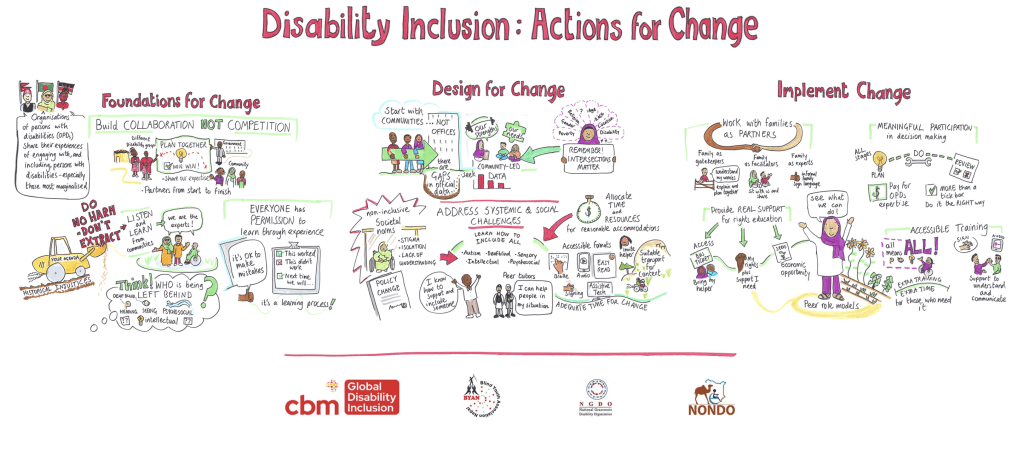
Please visit this link to view this infographics in accessible html format.
You can also download our Action for Change toolkit by visiting our Resource Page.
Welcome to our digital photo story book — a powerful collection of unheard and untold stories of persons with disabilities, captured and narrated by persons with disabilities themselves.
This project showcases authentic voices and perspectives, proving that disability does not limit creativity, vision, or determination.
We express our heartfelt gratitude to our mentor, Kishor Sharma, for his unwavering dedication and guidance.
A big thank you to all our passionate participants who turned this vision into reality.
This work was made possible through the generous support of CBM Global Disability Inclusion Nepal and CBM Global Disability Inclusion UK.
Together, we hope these stories spark reflection, empathy, and change.
Visit our resource page to view or download this photo story book.